

Cockpit Alert System Market to Reach USD 3.6 Billion by 2036, Expanding at 5.0% CAGR
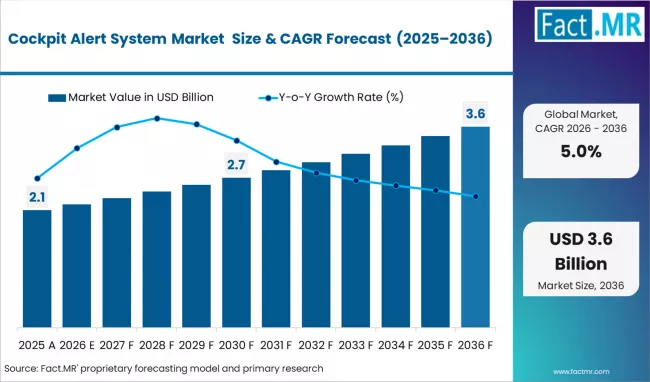
Cockpit Alert System market with expert analysis on growth drivers, trends, key insights, and forecast outlook to 2036.
ROCKVILLE, MD, UNITED STATES, March 21, 2026 /EINPresswire.com/ -- The global Cockpit Alert System Market is experiencing steady growth as safety remains a top priority across aviation and automotive industries. Cockpit alert systems are designed to provide real-time warnings, improve situational awareness, and assist operators in critical decision-making, making them essential for modern transportation systems.Industry insights indicate that the broader cockpit and safety system segment is expanding consistently, with the cockpit active safety warning system market projected to grow from approximately USD 2.73 billion in 2025 to USD 5.5 billion by 2035, registering a CAGR of around 7.2% during the forecast period.
Get Access of Report Sample: https://www.factmr.com/connectus/sample?flag=S&rep_id=14574
Rising Demand for Advanced Safety Systems Driving Market Growth
The increasing emphasis on passenger safety, accident prevention, and regulatory compliance is a major factor driving demand for cockpit alert systems. These systems are widely used in both aircraft cockpits and advanced automotive dashboards, where they provide alerts related to collision risks, system failures, and navigation hazards.
Key growth drivers include:
Stringent global safety regulations in aviation and automotive sectors
Rising adoption of advanced driver-assistance systems (ADAS)
Increasing air traffic and fleet expansion worldwide
Growing integration of AI, sensors, and real-time analytics
Demand for enhanced situational awareness and decision support systems
Technological advancements are enabling more accurate, predictive, and automated alert systems, significantly improving operational safety.
Sensor-Based and AI-Driven Systems Lead Market
By technology, sensor-based systems (radar, cameras, and ultrasonic sensors) dominate the market, providing real-time detection and alert capabilities.
Key technology segments include:
Radar-based alert systems
Camera and vision-based systems
Ultrasonic and LiDAR systems
AI-powered predictive alert systems
AI integration is emerging as a key trend, enabling predictive alerts and reduced false warnings, thereby enhancing system reliability.
Aviation and Automotive Applications Drive Demand
Cockpit alert systems are widely used across:
Commercial and military aviation (flight safety, navigation alerts, collision avoidance)
Automotive sector (lane departure warning, blind spot detection, collision alerts)
The aviation segment remains a critical application area, supported by increasing investments in advanced cockpit systems and safety technologies. At the same time, automotive adoption is accelerating due to the rise of connected and autonomous vehicles.
North America Leads, Asia-Pacific Emerging
North America dominates the cockpit alert system market due to:
Advanced aviation infrastructure
Strong regulatory frameworks
High adoption of safety technologies
Meanwhile, Asia-Pacific is emerging as a high-growth region, driven by:
Rapid expansion of commercial aviation
Increasing vehicle production
Government investments in transportation safety
Countries such as India and China are witnessing rising demand due to infrastructure development and technological adoption.
Competitive Landscape
The cockpit alert system market is moderately competitive, with key players focusing on innovation, system integration, and advanced sensor technologies.
Key companies include:
Robert Bosch GmbH
Continental AG
Denso Corporation
Valeo
Honeywell International Inc.
Collins Aerospace
Garmin Ltd.
These companies are investing in AI-enabled systems, integrated cockpit solutions, and advanced warning technologies to strengthen their market position.
Analyst Insight and Strategic Outlook
Industry analysts highlight that the market is evolving rapidly with the integration of digital avionics, smart cockpits, and connected vehicle ecosystems. The convergence of AI, IoT, and real-time data analytics is transforming cockpit alert systems into intelligent decision-support tools.
Additionally, increasing regulatory mandates for collision avoidance and safety monitoring systems are further accelerating adoption across industries.
Future Outlook
The cockpit alert system market is expected to grow steadily, driven by advancements in safety technologies and increasing demand for automation. Key opportunities are emerging in:
AI-driven predictive alert systems
Integration with autonomous vehicle platforms
Smart cockpit and digital avionics systems
Expansion in emerging aviation markets
As safety, automation, and connectivity become central to transportation systems, cockpit alert systems will continue to play a crucial role in enhancing operational efficiency and reducing risks, ensuring sustained market growth over the coming decade.
Browse Full Report: https://www.factmr.com/report/cockpit-alert-system-market
Purchase Full Report for Detailed Insights
For access to full forecasts, regional breakouts, company share analysis, and emerging trend assessments, you can purchase the complete report here: https://www.factmr.com/checkout/14574
Have a specific Requirements and Need Assistant on Report Pricing or Limited Budget please contact us - sales@factmr.com
To View Related Report :
Automotive Cockpit Electronics Market: https://www.factmr.com/report/automotive-cockpit-electronics-market
Driver Alert System Market: https://www.factmr.com/report/5360/driver-alert-system-market
Acoustic Vehicle Alerting System Market: https://www.factmr.com/report/acoustic-vehicle-alerting-system-market
Fuel System Diagnostics and Health Monitoring Market: https://www.factmr.com/report/fuel-system-diagnostics-and-health-monitoring-market
S. N. Jha
Fact.MR
+1 628-251-1583
email us here
Legal Disclaimer:
EIN Presswire provides this news content "as is" without warranty of any kind. We do not accept any responsibility or liability for the accuracy, content, images, videos, licenses, completeness, legality, or reliability of the information contained in this article. If you have any complaints or copyright issues related to this article, kindly contact the author above.
