

Regenerative Braking System Market to Reach US$ 18.2 Billion by 2033 at 10.2% CAGR | Persistence Market Research
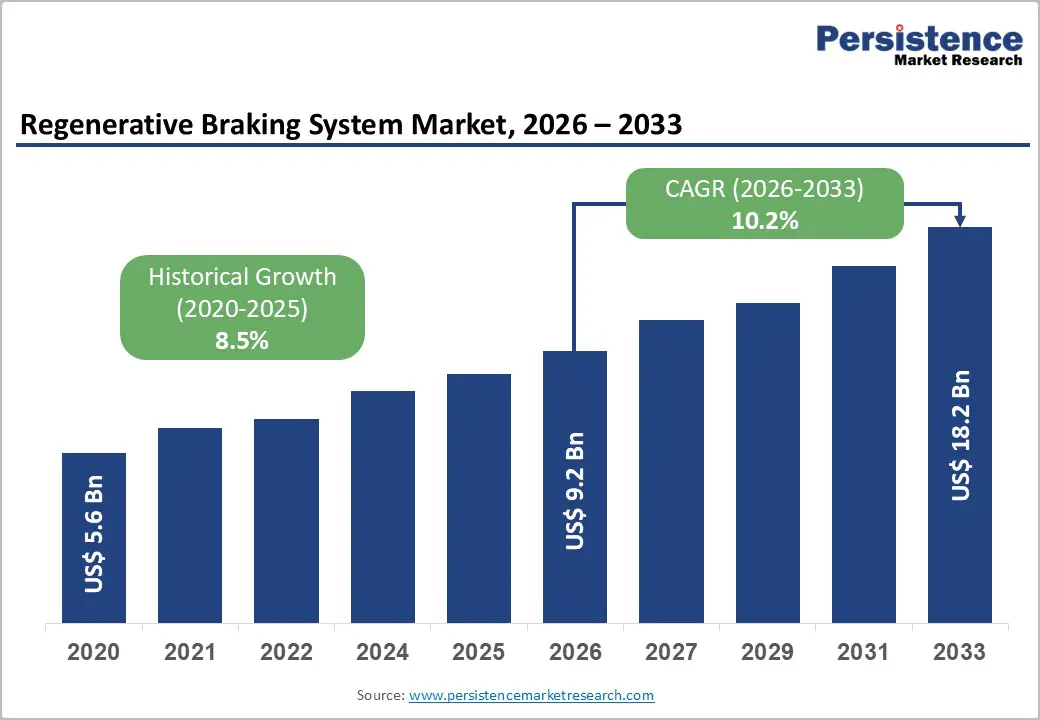
Regenerative Braking System Market
Expanding electric mobility and stringent emission standards are accelerating adoption of regenerative braking technologies globally.
BRENTFORD, LONDON, UNITED KINGDOM, May 6, 2026 /EINPresswire.com/ -- The regenerative braking system market is gaining strong momentum as the global automotive industry transitions toward energy-efficient and sustainable technologies. Regenerative braking systems capture kinetic energy during braking and convert it into usable electrical energy, significantly improving vehicle efficiency. This technology is widely used in electric vehicles (EVs), hybrid vehicles, and increasingly in advanced conventional vehicles. Growing environmental concerns, stringent emission regulations, and the rising demand for fuel-efficient transportation solutions are driving the adoption of regenerative braking systems across the automotive sector.
According to Persistence Market Research, the global regenerative braking system market is valued at approximately US$ 9.2 billion in 2026 and is projected to reach US$ 18.2 billion by 2033, growing at a CAGR of 10.2% between 2026 and 2033. Increasing production of electric and hybrid vehicles is a major growth driver, as these systems are integral to improving battery efficiency and driving range. The electric vehicle segment leads the market due to high integration of regenerative braking technology, while Asia Pacific emerges as the leading region driven by rapid EV adoption, strong manufacturing presence, and government incentives supporting clean mobility solutions.
Get Free Sample Now: https://www.persistencemarketresearch.com/samples/36557
Key Highlights from the Report
➤ The global regenerative braking system market is valued at US$ 9.2 billion in 2026 and is projected to reach US$ 18.2 billion by 2033, expanding at a CAGR of 10.2%.
➤ Rising adoption of electric and hybrid vehicles is significantly boosting demand for regenerative braking technologies worldwide.
➤ Stringent emission regulations are encouraging automakers to integrate energy recovery systems into modern vehicles.
➤ Technological advancements in energy storage and battery systems are enhancing the efficiency of regenerative braking systems.
➤ Asia Pacific dominates the market due to rapid EV adoption, supportive government policies, and strong automotive manufacturing base.
➤ Increasing focus on fuel efficiency and sustainability is driving innovation and investment in regenerative braking solutions.
Market Segmentation
By Component
• Battery
• Motor
• ECU (Electronic Control Unit)
• Flywheel
By Propulsion
• BEV (Battery Electric Vehicle)
• PHEV (Plug-in Hybrid Electric Vehicle)
• FCEV (Fuel Cell Electric Vehicle)
By Vehicle Type
• Passenger Car
• Light Commercial Vehicle
• Heavy Commercial Vehicle
• Electric Vehicles
By Region
• North America
• Europe
• East Asia
• South Asia and Oceania
• Latin America
• Middle East and Africa
Regional Insights
North America
North America represents a significant market for regenerative braking systems due to increasing adoption of electric vehicles and stringent emission standards. Governments in the region are promoting clean transportation through incentives and regulatory frameworks. The presence of major automotive manufacturers and technological advancements further support market growth.
Europe
Europe is a key market driven by strict environmental regulations and strong commitment to reducing carbon emissions. The region has witnessed rapid growth in electric vehicle adoption, supported by government subsidies and infrastructure development. Automotive manufacturers in Europe are actively integrating regenerative braking systems to meet regulatory requirements and enhance vehicle efficiency.
Asia Pacific
Asia Pacific leads the regenerative braking system market due to high production and sales of electric vehicles. Countries in the region are investing heavily in EV infrastructure and promoting sustainable mobility solutions. The presence of major automotive manufacturers and a growing middle-class population contribute to strong demand for energy-efficient vehicles.
Request For Customization: https://www.persistencemarketresearch.com/request-customization/36557
Market Drivers
The rapid growth of electric and hybrid vehicles is a major driver for the regenerative braking system market. As automakers focus on improving vehicle efficiency and reducing emissions, regenerative braking systems have become essential components. These systems enhance battery performance by recovering energy that would otherwise be lost during braking. The increasing demand for longer driving range and better fuel efficiency is encouraging manufacturers to adopt advanced regenerative braking technologies.
Government regulations aimed at reducing carbon emissions are also driving market growth. Many countries have introduced strict emission standards and fuel efficiency norms, pushing automakers to integrate energy recovery systems. Additionally, rising fuel prices and growing environmental awareness among consumers are accelerating the adoption of fuel-efficient technologies. Continuous advancements in battery technology and energy storage systems are further enhancing the performance and reliability of regenerative braking systems.
Market Opportunities
The regenerative braking system market offers significant opportunities as the global automotive industry moves toward electrification. Increasing investments in electric vehicle production and infrastructure are expected to create strong demand for energy-efficient technologies. Emerging markets present untapped potential as governments introduce policies to promote clean mobility and reduce dependence on fossil fuels.
Technological advancements are opening new avenues for market growth. Innovations in ultracapacitors, battery systems, and energy management technologies are improving the efficiency and reliability of regenerative braking systems. Integration of smart technologies and advanced control systems is enhancing system performance and enabling real-time energy optimization. As the automotive industry continues to evolve, regenerative braking systems are expected to play a crucial role in shaping the future of sustainable transportation.
Key players operating in the regenerative braking system market include:
• Robert Bosch GmbH
• Denso Corporation
• Continental AG
• ZF Friedrichshafen AG
• BorgWarner Inc.
• Hyundai Mobis
• Eaton
• Brembo S.P.A.
• Skeleton Technologies GmbH
• Advics Co. Ltd.
Buy Now: https://www.persistencemarketresearch.com/checkout/36557
Recent Developments
• March 2024 – A leading automotive technology company introduced an advanced regenerative braking system designed to improve energy recovery efficiency in electric vehicles.
• November 2023 – A major automotive supplier expanded its regenerative braking technology portfolio to support next-generation hybrid and electric vehicle platforms.
Future Opportunities and Growth Prospects
The regenerative braking system market is expected to witness sustained growth driven by the global shift toward electric mobility and energy-efficient technologies. Increasing investments in EV infrastructure, advancements in energy storage solutions, and rising environmental awareness will continue to support market expansion. As automotive manufacturers focus on innovation and sustainability, regenerative braking systems will remain a key technology in enhancing vehicle efficiency and reducing environmental impact.
Explore the Latest Trending Research Reports:
Motorcycle Market
Electric Bus Market
Persistence Market Research
Persistence Market Research Pvt Ltd
+1 646-878-6329
email us here
Visit us on social media:
LinkedIn
Instagram
Facebook
YouTube
X
Legal Disclaimer:
EIN Presswire provides this news content "as is" without warranty of any kind. We do not accept any responsibility or liability for the accuracy, content, images, videos, licenses, completeness, legality, or reliability of the information contained in this article. If you have any complaints or copyright issues related to this article, kindly contact the author above.
